
In this article
- What scoliosis is and why it often shows up in adolescence
- Early detection: one bend can start a self-check
- Mild to moderate: observation and exercise first
- How to do core stability and posture training
- One teen's journey to rebuilding posture
- When professional correction is needed
While picking a backpack for your child, have you noticed one shoulder sitting higher than the other when they stand tall? Scoliosis often appears quietly during adolescence, usually with no obvious discomfort early on. Catching it early is the key to making the most of the window for intervention.
What scoliosis is and why it often shows up in adolescence
Scoliosis is a sideways curve of the spine, usually with rotation, forming a C or S shape when viewed from behind. The most common type is idiopathic (cause unknown) and tends to appear during the growth spurt between ages 10 and 15.
Because bones grow quickly in this stage, the curve can increase along with them—which is exactly why adolescence is an important time to watch and act.
Early detection: one bend can start a self-check
You can do a simple Adam's forward bend test at home: have your child stand with feet together, press their palms together, and bend forward naturally. From behind at eye level, look for one side of the back sitting higher than the other.
Other clues include uneven shoulders, one shoulder blade sticking out more, an asymmetric waistline, or trouser legs that look uneven. If something seems off, don't judge it yourself—a doctor should confirm the curve by measuring the Cobb angle on an X-ray.
Mild to moderate: observation and exercise first
The Cobb angle guides how the curve is managed. Generally, mild curves (about 10 to 20 degrees) are handled with regular monitoring and exercise, while moderate curves (about 20 to 40 degrees in a still-growing child) may add a brace.
One common misunderstanding is worth clearing up: exercise itself can't "correct" a curve that has already formed in the bone. But regular core and posture training can strengthen support, ease discomfort, improve how the body carries itself, and maintain flexibility—an important part of overall care.
How to do core stability and posture training
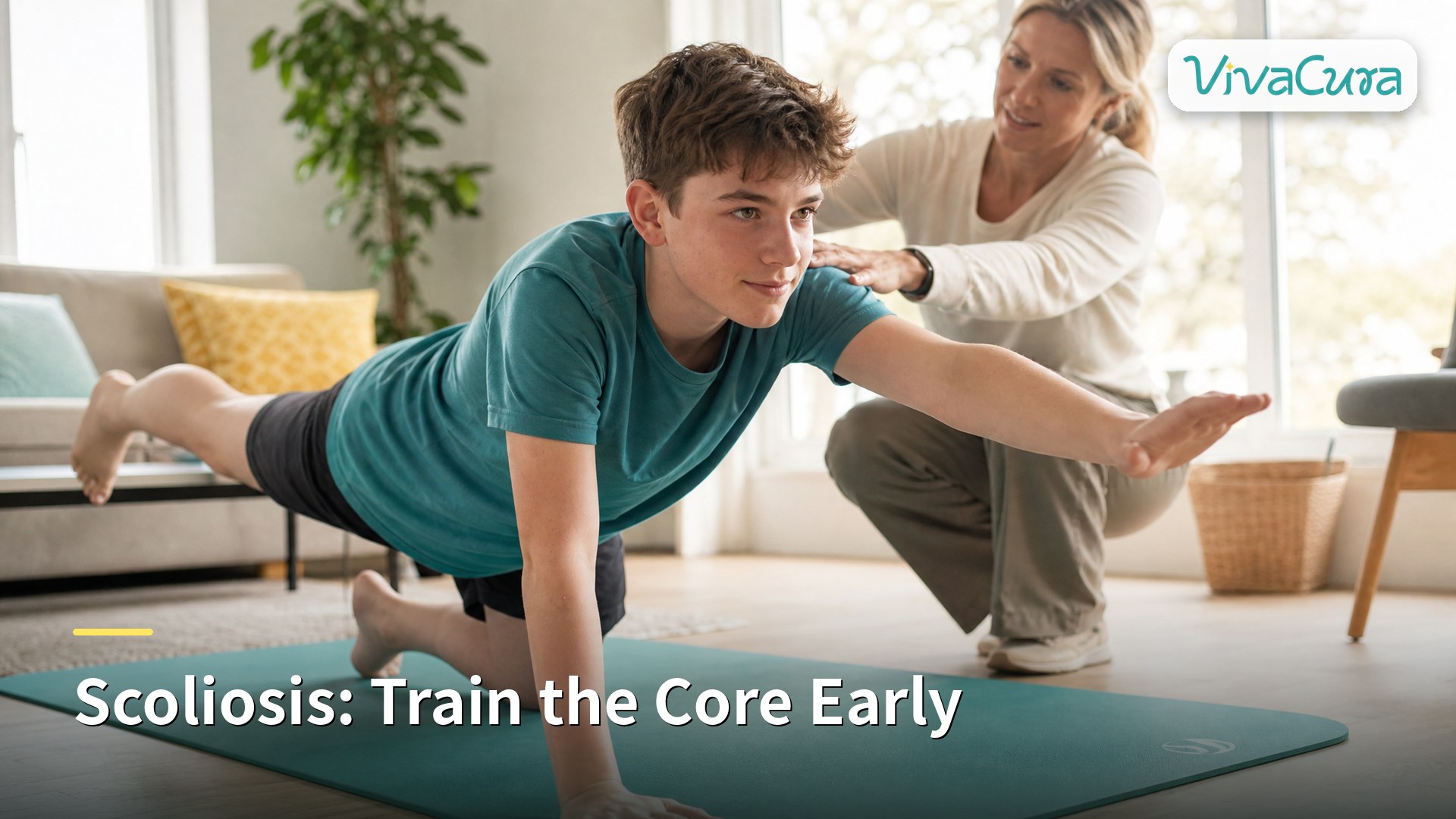
The core refers to the deep muscles around the abdomen, back, and pelvis that stabilize the spine like a natural back brace. The plank, bird-dog, and bridge are safe, effective starting moves.
Symmetry- and stretch-focused activities such as swimming, Pilates, and yoga are also often recommended. The key is to progress gradually with correct form—ideally starting under professional guidance to avoid compensation or injury.
One teen's journey to rebuilding posture
Thirteen-year-old Emma was found to have a mild curve at a school screening, with a Cobb angle of about 15 degrees. Her doctor advised monitoring and referred her to a physiotherapist to design a core program.
She trained core and stretching three times a week and adjusted how she carried her backpack and sat at her desk. At her follow-up six months later, the angle was stable and hadn't worsened, and her long-standing lower-back tightness had eased. Her happiest part, Emma said, was that "in front of the mirror, I feel like I'm standing taller."
When professional correction is needed
When the Cobb angle keeps increasing past a certain point (usually above 40 to 45 degrees) or begins to affect heart and lung function, a doctor may evaluate professional options such as bracing or surgery.
Remember: exercise is a supplement, not a substitute for medical assessment. Regular follow-up and following the advice of an orthopedic or rehabilitation specialist is the safe path.
In closing
With scoliosis, the two most powerful things are early detection and regular training. Mild-to-moderate curves can often stay stable through monitoring plus core and posture work; more severe cases need professional correction. Exercise helps a child stand steadier and more confident—but it is a partner to medical care, not a replacement. Want to help your child build a strong core and good posture? See our picks below for home-training and posture-support essentials to help you straighten up, step by step.
Read more: Exercise Advice for Kids With Asthma: Building Stamina Safely (G5-099)
Sources: Scoliosis Research Society (SRS) clinical consensus; American Academy of Orthopaedic Surgeons (AAOS) patient education; clinical orthopedics and physiotherapy core-training textbooks.